


The Partner List
You cannot route data into the dark.
You need destinations.
The Curator never says “pipeline.”
He says “partners.”
The Custodian never says “infrastructure.”
He says “stability.”
But stability requires nodes.
And nodes have names.
Incident Trigger
08:42 PM | Laconia
The envelope from Case File 009 is not the only thing that arrived.
Tucked inside the clinic’s shared printer queue—misfiled, briefly visible, then gone—was a document titled:
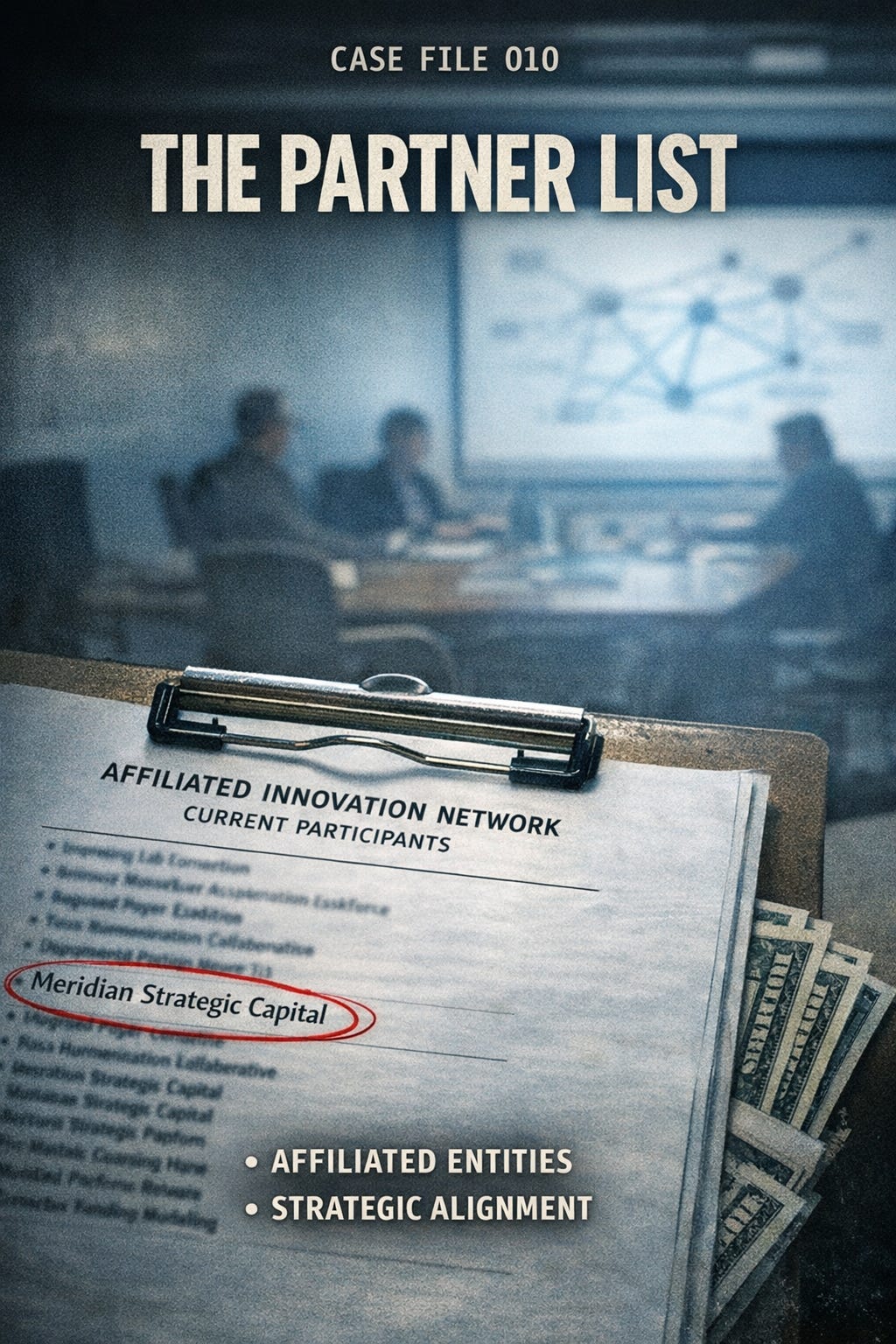
AFFILIATED INNOVATION NETWORK — CURRENT PARTICIPANTS
Not a public page.
Not a brochure.
A working list.
Twenty-seven entities.
Seven grant channels.
Three advisory bodies.
Two venture intermediaries.
One capital structuring firm.
Vivian printed it before it disappeared.
The Structure
The list does not read like a villain registry.
It reads like legitimacy.
University lab consortium
National biomarker acceleration taskforce
Regional payer coalition
Supplement innovation incubator
Data harmonization collaborative
Meridian Strategic Capital
There it is.
Not in bold.
Not highlighted.
Just present.
Vivian circles it anyway.
Cross-Reference
CID_PROTOCOL consent addendum language allows:
“Data may be shared with partners and affiliated entities for innovation and quality improvement.”
The Partner List defines those entities.
The harmonization export routes studies externally.
The LAC-3 stamp appears on consent paperwork.
Three systems.
One loop.
Consent broadens access.
Harmonization structures velocity.
Partners receive structured data.
No theft required.
Just authorization.
The Alignment Problem
Vivian maps the overlap.
Foundation trustee
also advisory board
also grant allocator
also capital chair
The Double Seat.
Not illegal.
Not hidden.
Simply aligned.
The same entities influencing:
Diagnostic weighting thresholds
Research cohort construction
Reimbursement modeling
Innovation funding
Innovation is not the crime.
Opacity is.
The Language
The Curator says:
“Partners enhance care.”
The Custodian says:
“Fragmentation harms continuity.”
The Partner List says:
“Strategic alignment.”
Vivian writes in the margin:
Alignment is where accountability goes to dissolve.
Financial Incentive Layer
Pathway Three accelerates certain profiles.
Accelerated profiles:
Enter treatment modules earlier
Generate utilization codes sooner
Contribute to outcome datasets faster
Stabilize projected burden curves
Delay costs money.
Velocity contains it.
Velocity also generates structured cohorts attractive to funders.
The Partner List includes:
Two analytics platforms
One outcomes modeling firm
One pharmaceutical infrastructure consultant
No conspiracy.
Just incentive gravity.
The Critical Question
Is consent status part of pathway eligibility weighting?
If families opt out of CID expansion—
Does their data remain local?
Does their case remain Pathway Two longer?
Is “innovation participation” functionally tied to velocity?
No documentation confirms this.
But the systems are adjacent enough to ask.
And adjacency is design’s favorite disguise.
Exhibit A
Overlay of Pathway Three timestamps against CID consent adoption rollout.
Acceleration increases in the quarter following consent expansion.
Correlation is not causation.
But correlation is rarely random at scale.
Exhibit B
Internal phrase overheard:
“Scope lock her.”
Scope of what.
Lock of whom.
If the Partner List is benign—
Why fear scrutiny.
What We Know
A Partner List exists defining “affiliated innovation entities.”
CID consent expansion broadens data sharing indefinitely.
Harmonization exports LAC-3 cases externally.
Meridian Strategic Capital appears on both infrastructure and innovation lists.
What We Do Not Know
Whether consent status influences pathway velocity.
Which partner receives harmonized exports directly.
Whether the Custodian is stabilizing risk curves—or protecting capital flows.
Assessment
The system does not need to lie.
It needs alignment.
Families sign to move forward.
Pathway Three moves faster.
Data travels farther.
Innovation benefits.
The Curator acquires authorization.
The Custodian acquires stabilization.
And somewhere inside the structured cohort—
A patient’s timeline shifts.
Not because of error.
Because of design.
Closing Hook
Vivian Quinn has seen the signature trap.
Now she has seen the destinations.
If consent opens the gate—
And Pathway Three controls velocity—
Then the next case is not about permission.
It is about consequence.
Because once you build a pipeline—
The question is not whether it moves data.
It is what it does to the people inside it.
Next Case:
Case File 011 — The Moving Line
When diagnostic thresholds shift after the dataset matures.