


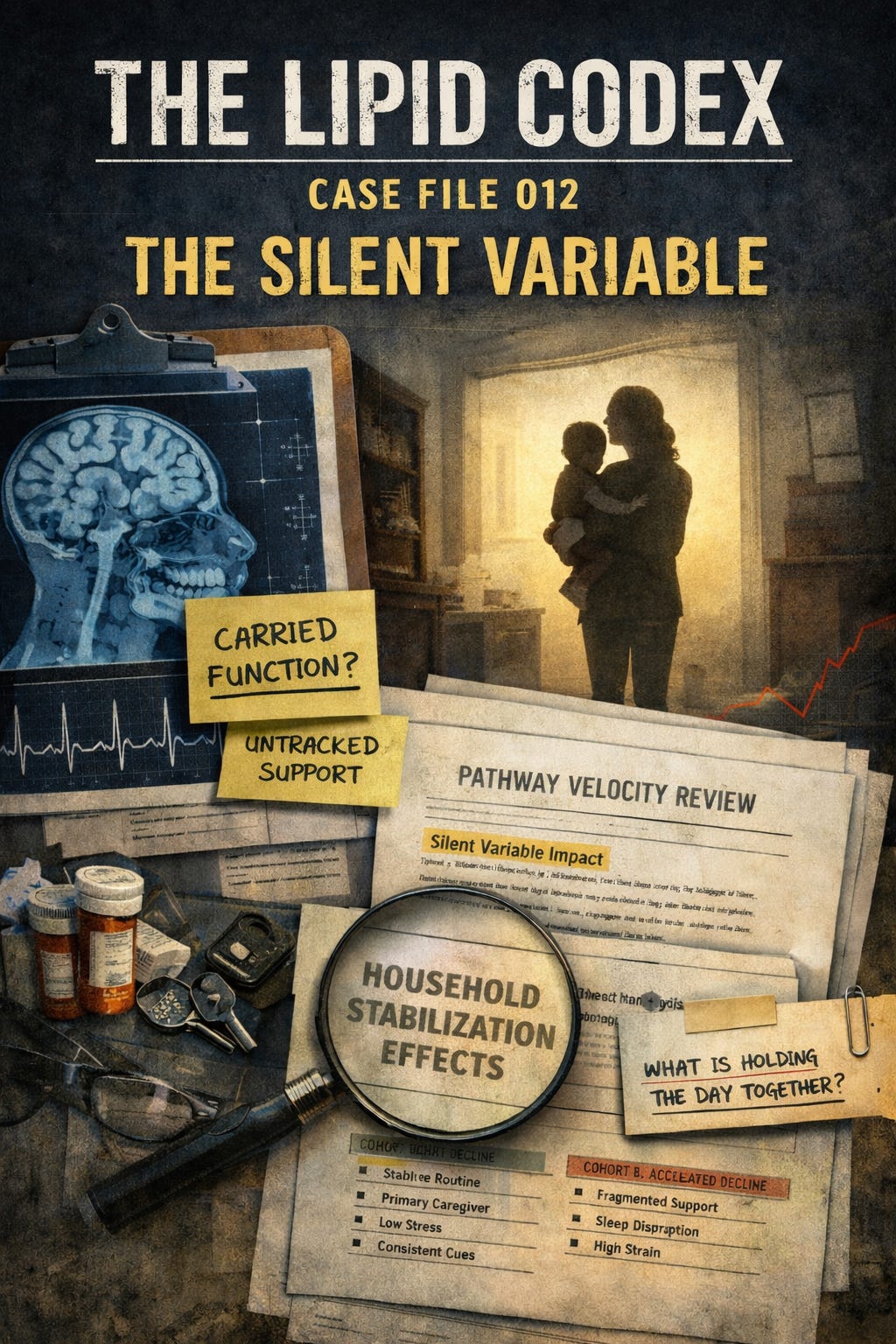
The factor changing outcomes most is often the one nobody coded.
Vanessa Saunders
Mar 12, 2026
There is always a column missing.
Not because no one noticed.
Because no one built the model to honor it.
Intake Notes
Medicine prefers variables that stay still.
Age.
Weight.
Lab values.
Imaging markers.
Genetics.
Scores that can be entered, sorted, and defended in a meeting with fluorescent lighting and stale muffins.
What it distrusts are variables that move through kitchens.
Routine.
Interruption.
Sleep debt.
Stress.
Noise.
Care load.
The invisible labor required to keep one person functional long enough to look “stable” on paper.
The Curator calls these factors “context.”
The Custodian calls them “confounds.”
Vivian Quinn has another term.
Unbilled infrastructure.
Because what the chart records as function is often being quietly held up by someone the model never counted.
Incident Trigger
07:18 AM | Concord
Vivian arrives before the first real wave of staff.
The building is still pretending to be honest.
A junior analyst with the posture of a man who has apologized to systems his whole life leaves a print job sitting in the tray.
He notices too late.
Vivian notices first.
Title:
PATHWAY VELOCITY ADJUSTMENT REVIEW
Subheader: Non-Biological Stabilizers
She does not touch it immediately.
That is how fear works in institutions. It teaches you to hesitate in front of evidence.
Then she remembers the file room.
She picks it up.
Three pages.
Internal circulation.
No public footer.
The phrase appears six times.
Silent variable.
Not poetic.
Not philosophical.
Operational.
By the second paragraph, her coffee has gone cold.
The Document
The review is not about amyloid.
Not exactly.
It is about model drift.
Cases expected to decline at one pace are declining at another.
Predicted progression does not match observed progression across several cohorts.
Pathway timing is slipping.
Eligibility windows are widening in some patients and collapsing in others.
Utilization forecasts are becoming noisy.
The original assumption was biological inconsistency.
The memo says otherwise.
A highlighted line:
Observed variance may reflect unmeasured household stabilization effects.
Vivian reads it twice.
Then a third time, because the cruelty of bureaucracy is often hidden inside accurate language.
Household stabilization effects.
Not wife.
Not husband.
Not daughter.
Not exhausted supporter setting out pills, re-explaining Tuesday, maintaining meals, adjusting light, lowering stress, rescuing routines, and quietly carrying the day over every pothole.
Just household stabilization effects.
As if love were a setting.
The Problem
When a patient appears stable, the model assumes the brain is stable.
That is the error.
The memo identifies repeated mismatch across LAC-tagged cases where measured pathology and observed daily function fail to align.
Some patients with worsening scans remain functionally higher than expected.
Others with similar pathology deteriorate faster in lived settings than the pathway predicted.
The biological markers are not wrong.
The model is incomplete.
The missing input is not inside the skull.
It is the structure around it.
Not just whether support exists.
Whether support is skilled.
Whether it is consistent.
Whether the environment is calm.
Whether routine is preserved.
Whether the person’s remaining strengths are being used instead of abandoned.
The document does not use words like dignity or familiarity or trust.
It uses this instead:
external compensatory continuity
Which is what happens when a system fears the human name for something.
Cross-Reference
Vivian pulls her notes from previous files.
Case File 009: The Consent Problem
Families sign to keep moving forward.
Case File 010: The Partner List
Pathway velocity depends on structured data and aligned incentives.
Case File 011: The Moving Line
Committees adjust thresholds when the curve bends.
Now the mechanism sharpens.
If the dataset did not properly account for external compensatory continuity, then the curve was never purely biological to begin with.
Not false.
Contaminated by omission.
One household keeps the person oriented, nourished, rested, cued, and steady.
Another is underwater by breakfast.
The scan may look similar.
The day does not.
Yet the day was treated as noise.
And noise, once excluded long enough, becomes policy.
Exhibit A
Recovered Language from Pathway Velocity Adjustment Review
Original term under discussion:
Supporter-mediated functional preservation
Revised final language:
Non-biological stabilizer
Rejected alternative:
Environmental continuity factor
Vivian’s note:
Every revision moved the truth farther from the person doing the work.
Exhibit B
Margin Annotation, unidentified hand
“Model assumes observed function = intrinsic reserve.”
“False in householded cases.”
“Need separation between pathology and carried function.”
Underlined twice:
Carried function
Vivian circles it.
There it is.
Not improvement.
Not recovery.
Not proof the disease paused to be polite.
Carried function.
The part of daily life being upheld by unseen structure the system does not measure, reimburse, or respect.
Exhibit C
Mismatch Table: LAC-3 subgroup summary
Cohort A: high pathology / delayed decline
Common factors:
stable morning routine
single primary supporter
repeated task cues
low environmental variability
preserved familiar activity engagement
Cohort B: moderate pathology / accelerated decline
Common factors:
fragmented support coverage
sleep disruption
frequent setting changes
high caregiver strain
reduced continuity of familiar tasks
Internal conclusion:
Behavioral trajectory may be significantly altered by untracked domestic scaffolding.
Vivian’s note:
Domestic scaffolding. Another phrase that manages to sound structural and insulting at the same time.
Exhibit D
Field Card: What the Model Refused to Count
If the person looks stable, ask who is holding the day together.
If a score improves, ask what changed around the person.
If a decline accelerates, ask what support collapsed before assuming the biology suddenly sprinted.
If the model counts plaques but not panic, pathology but not routine, biomarkers but not burden, it is not precise.
It is partial.
Bottom line:
What is left out of the spreadsheet does not stay out of the outcome.
Assessment
The Silent Variable is not a mystery anymore.
It is not even especially silent.
The families have been shouting it for years.
The silence belongs to the model.
This is what the files now suggest:
The pathway was built as if observed function were a direct readout of disease stage.
But observed function is often a collaboration.
Part brain.
Part environment.
Part compensation.
Part structure.
Part the unpaid intelligence of whoever is keeping the household from breaking apart.
That has consequences.
If carried function masks decline, diagnosis may come later than it should.
If support collapse unmasks fragility, decline may appear more abrupt than the biology alone would predict.
If preserved strengths are actively reintroduced, a person may function better than the pathway expects.
If they are stripped of routine, role, rhythm, and dignity, the curve may worsen for reasons the scan cannot explain.
Which means the line in Case File 011 did not merely move because science matured.
It moved on top of data that had never fully separated disease from scaffolding.
Not fraud.
Not fantasy.
Just a dangerous overconfidence in what the system chose to count.
What We Know
A review document exists identifying a “silent variable” in pathway prediction.
That variable is tied to unmeasured household stabilization, supporter load, routine continuity, and environmental scaffolding.
LAC-tagged cases appear repeatedly in mismatch analysis.
Internal language shows deliberate renaming of human support into sterile operational terms.
The model may be conflating intrinsic reserve with carried function.
What We Do Not Know
Who first identified the silent variable and whether they were overruled.
Whether pathway timing, eligibility, or reimbursement logic will be reweighted to reflect it.
How many prior threshold decisions were shaped by datasets that failed to isolate carried function from actual disease progression.
Whether the Custodian is preserving this finding for correction or shelving it until it becomes administratively safe.
Closing Hook
Vivian Quinn closes the file and looks at the line she copied into her notebook:
The model assumed the patient was standing alone.
That was the error.
No one stands alone in this disease.
Not at first.
Not in the middle.
Not while there is still someone in the next room listening for the drawer, the footstep, the silence that means trouble.
The system called that support.
The review called it a variable.
Vivian called it motive.
Because once you realize the model was built on uncounted labor, the next question is no longer scientific.
It is financial.
Who benefits when the work holding a person together remains measurable in reality, but invisible on paper?
And what happens when someone finally decides to count it?
Next Case
Case File 013: The Proxy Problem
When the system stops measuring the person directly and starts trusting a substitute that was never neutral.