


When the system stops measuring the person directly and starts trusting a substitute that was never neutral.
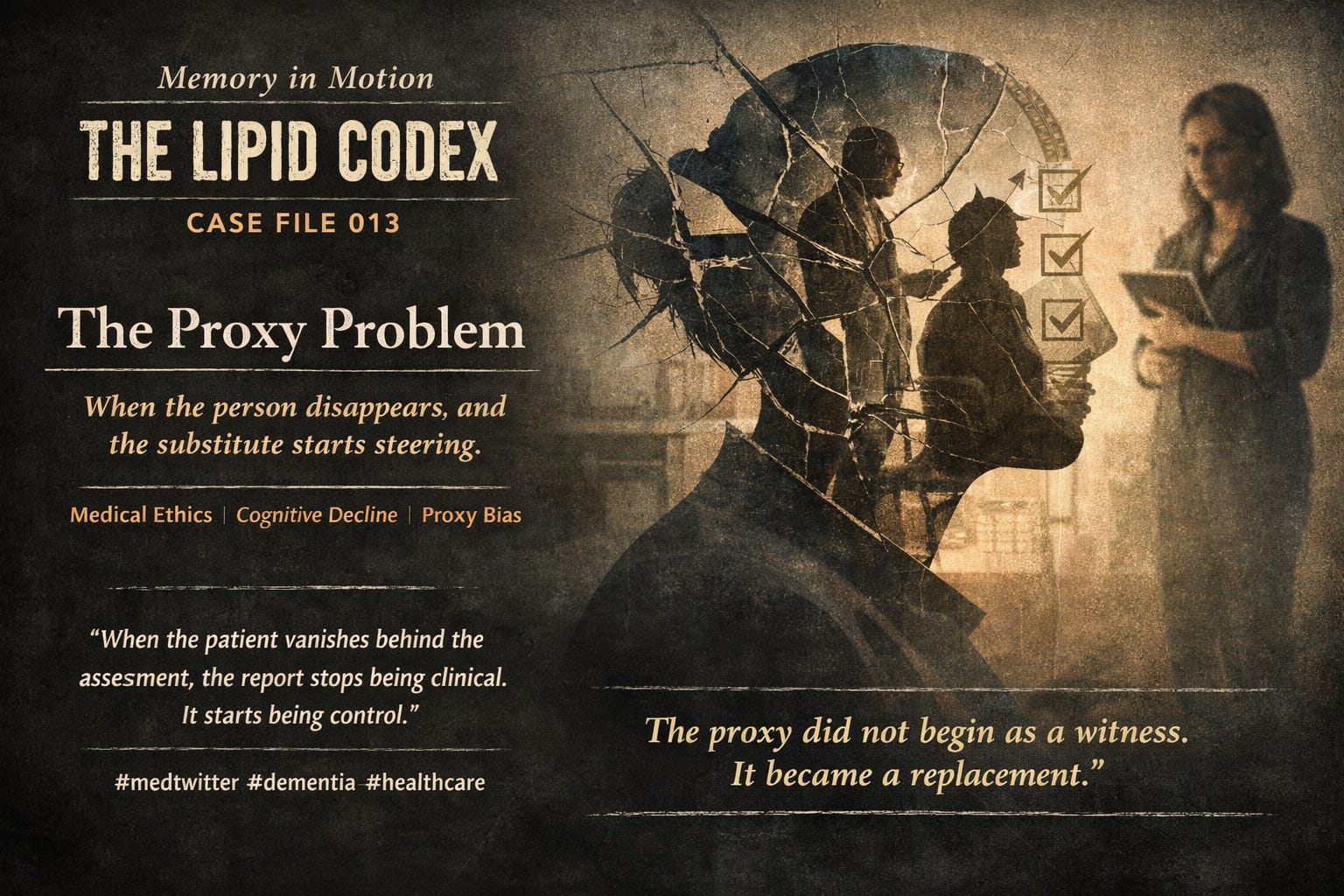
That is when institutions invent a proxy.
Something easier to capture.
Cleaner to chart.
Cheap enough to repeat.
A score.
A form.
A caregiver impression.
A billing code.
A compliance marker pretending to be a life.
And once the proxy is accepted, the person begins to disappear behind it.
Not dramatically.
Administratively.
Intake Notes
The problem with proxies is not that they are always wrong.
It is that they are tolerated as if they were neutral.
Medicine does this all the time.
Pain becomes a number.
Function becomes a checklist.
Confusion becomes a screening score.
Daily life becomes a structured impression relayed by someone else at speed in a room where the clock matters more than accuracy.
The Curator calls this efficient abstraction.
The Custodian calls it necessary standardization.
Vivian Quinn calls it distance with a billing code.
Because once a system decides it no longer needs to see the person directly, it begins accepting substitutes for reality.
And substitutes, unlike people, do not complain when they are misused.
Incident Trigger
08:42 AM | Manchester
The clinic is running nineteen minutes behind and pretending that is a moral virtue.
Vivian sits in the far corner of the neurology waiting room beside a ficus that has survived on neglect and municipal lighting.
Across from her, a husband in a navy quarter-zip is trying to answer three intake questions at once while his wife studies the aquarium like it might contain instructions.
At the front desk, a medical assistant asks him whether the patient has had “any recent decline in executive function.”
He hesitates.
That is the first honest thing in the room.
His wife speaks before he can answer.
“I still make a lovely roast chicken.”
The assistant smiles with the air of someone trained to treat dignity like a scheduling obstacle.
Then she turns back to the husband.
“So should I put moderate decline?”
Vivian looks up.
There it is.
The handoff.
Not from truth to lie.
From person to proxy.
The patient is still in the chair.
Still speaking.
Still here.
But the system has already turned to the substitute.
The File
What lands on Vivian’s desk later that morning is marked:
PROXY RELIANCE REVIEW
Subclassification: Functional Assessment Substitution Pathways
She reads the title twice.
Then once more, because institutions often hide the knife in the noun.
This document is not about one clinic or one sloppy intake desk.
It is about scale.
Across multiple sites, pathway decisions are increasingly driven not by direct observation of the patient, but by secondary reporting inputs:
caregiver questionnaires
supporter distress inventories
compliance logs
utilization markers
visit summaries written by rotating staff
abbreviated functional screens performed under variable conditions
The document notes a growing dependence on proxy-derived data in cases where direct patient reporting is considered unreliable, incomplete, inefficient, or “contextually inconsistent.”
Contextually inconsistent.
A phrase designed to make human complexity sound like a software glitch.
Vivian keeps reading.
By paragraph four, the review stops being clinical and starts being political.
A highlighted line:
Proxy capture has become functionally determinative in pathway assignment for selected cognitive cases.
Functionally determinative.
Not supportive.
Not supplementary.
Determinative.
The substitute is no longer informing the decision.
It is making it.
The Shift
The old model was flawed, but at least it retained the theater of direct assessment.
Ask the patient.
Observe the patient.
Test the patient.
Pretend, for one ceremonial hour, that the person still occupied the center of the process.
The newer pathway is less sentimental.
It assumes that once cognition becomes messy, the cleanest narrative will come from someone nearby.
A spouse.
An adult child.
A paid aide.
A case manager.
A rotating combination of all four.
This is sold as realism.
Sometimes it is.
But the review identifies a dangerous slippage.
The proxy is not merely reporting on the patient.
The proxy is reporting from inside their own exhaustion, fear, expectations, grief, preferences, and tolerance thresholds.
Which means the system is not just measuring the person.
It is measuring the relationship around them.
And pretending it is the same thing.
Cross-Reference
Vivian spreads three earlier files across the desk.
Case File 009: The Consent Problem
Who signs when clarity flickers.
Case File 011: The Moving Line
Who becomes a patient when thresholds shift.
Case File 012: The Silent Variable
How uncounted household labor changes visible outcomes.
Now the shape sharpens again.
If carried function distorted the pathway from one side, proxy reporting can distort it from the other.
One supporter minimizes to protect hope.
Another overstates because they are drowning.
A third answers with terrifying accuracy but gets translated into bureaucratic mush by intake staff who have never lived through a Tuesday in that house.
The pathology may be real.
The stress may be real.
The decline may be real.
But the record is no longer a direct line from person to chart.
It is a relay race through fear.
Exhibit A
Internal Language Table: Proxy Inputs
Original term:
Caregiver report
Revised pathway term:
Collateral functional source
Alternative under consideration:
Reliability-adjusted observer account
Vivian’s note:
Every version moves the human farther from the sentence and the bias closer to invisibility.
Exhibit B
Margin Notes from Review Copy, author redacted
“Proxy confidence varies with burden.”
“High-strain households show elevated decline reporting independent of direct testing.”
“Low-insight patients may underreport.”
“High-control supporters may over-shape narrative.”
“Need distinction between observed impairment and relational interpretation of impairment.”
Underlined three times:
relational interpretation
Vivian circles it hard enough to score the page.
Because that is the whole disease economy in six syllables.
Not just what is happening.
What someone else believes is happening.
What they fear is happening.
What they need the system to recognize.
What they need it to fund.
What they need it to stop asking of them.
Exhibit C
Proxy Distortion Matrix | LAC-3 Aligned Cases
Pattern 1: Understatement bias
Common setting:
spouse protecting independence
patient socially skilled in clinical settings
decline compensated at home
supporter reluctant to “betray” partner
Documented effect:
delayed escalation
missed need for support
inflated apparent stability
Pattern 2: Exhaustion amplification
Common setting:
fragmented sleep
single supporter load
high daily repetition burden
unmanaged household strain
Documented effect:
accelerated reported decline
higher urgency coding
increased pathway compression
Pattern 3: Control narrative substitution
Common setting:
dominant family reporter
patient interrupted or corrected during visits
clinician time-limited
direct patient input truncated
Documented effect:
patient voice minimized
relational dynamic misread as impairment
proxy account treated as objective record
Internal conclusion:
Proxy-derived data may reflect disease status, supporter burden, household conflict, compensation structure, or some unstable mixture of all four.
Vivian’s note:
There it is. The substitute was never neutral. It was a weather system.
Exhibit D
Field Card: Questions the Pathway Avoided
When the supporter answers first, ask whether the patient was given room.
When the report sounds severe, ask how much sleep the household got.
When the patient sounds “better than expected,” ask what is being covered, rehearsed, or carried.
When the account sounds polished, ask who benefits from that version surviving the chart.
When the proxy becomes the record, ask whether the person has been replaced by convenience.
Bottom line:
A substitute can carry information without carrying truth cleanly.
The Mechanism
This is how the error multiplies.
A hurried clinician trusts the spouse because time is short.
The spouse answers from burnout because burnout is now the family language.
The note captures mood as function.
The next team reads the note as fact.
The coded fact shapes eligibility, treatment timing, supervision assumptions, and reimbursement.
And by the end of the chain, nobody can remember where observation stopped and interpretation began.
The system loves this kind of drift.
Not because it is evil in the theatrical sense.
Because it is operationally convenient.
A direct assessment takes time.
Context.
Patience.
Follow-up.
Comparison across settings.
A willingness to notice contradiction without treating it like insubordination.
A proxy takes one checkbox and a nod.
The difference is cost.
Assessment
The Proxy Problem is not that families lie.
Most are doing their best while sleep-deprived and frightened.
The problem is structural.
The system imports their testimony as if it arrives untouched by love, panic, resentment, guilt, habit, status, or survival.
It does not.
No human report does.
Not the patient’s.
Not the spouse’s.
Not the clinician’s either.
But only one of those reports is routinely granted the quiet authority of substitution.
That matters.
Because once proxy data becomes determinative, the person with the disease begins living inside someone else’s language.
If the proxy minimizes, the person may be denied help.
If the proxy catastrophizes, the person may be stripped of agency faster than necessary.
If the proxy dominates, the person may vanish from their own file while still sitting in the chair.
This is not merely a documentation problem.
It is a custody problem.
Who has narrative control over the patient once the patient becomes difficult to summarize?
What We Know
A review document exists identifying rising proxy reliance in cognitive pathway assignment.
Internal language confirms that proxy-derived inputs are no longer merely supportive in some cases, but functionally determinative.
Evidence suggests reported function may reflect a mixture of disease status, supporter burden, relational dynamics, and environmental strain.
LAC-linked cases appear again in mismatch review, particularly where patient presentation and proxy narrative diverge.
The system has operational incentives to prefer substitute reporting over direct, time-intensive observation.
What We Do Not Know
Who authorized proxy capture to become determinative rather than supplemental.
Whether clinicians are being trained to separate supporter burden from patient status in a disciplined way.
How many pathway decisions have already been shaped by narrative substitution rather than observed function.
Whether the Custodian sees this as a correctable distortion or a useful administrative shortcut.
Closing Hook
Vivian closes the file and thinks of the woman in the waiting room.
“I still make a lovely roast chicken.”
It was not a joke.
It was evidence.
Evidence of memory.
Of rhythm.
Of retained sequence.
Of pride.
Of selfhood still alive enough to answer the question beneath the question.
But the room did not want that kind of evidence.
It wanted the faster version.
The cleaner version.
The one that could be entered by someone standing beside her.
Vivian writes one line in her notebook and underlines it once:
The proxy did not begin as a witness. It became a replacement.
And once a system accepts replacement as efficiency, the next corruption is inevitable.
Because the question is no longer whether the patient can still speak.
It is whose version of the patient the pathway has decided to trust.
And once that choice starts steering timing, eligibility, and money, the proxy is no longer clinical.
It is power.
Next Case
Case File 014: The Lag Window
When the damage is already happening, but the system is still waiting for the paperwork to catch up.
Oh my goodness , these truths apply to many kinds of visits to the Doctor these days . The clergy gets this more than the medical community , me thinks ….