


New here? Start with the practical MiM “Start Here” post, then return to The Lipid Codex for the case files.
There is a stage before diagnosis that almost nobody wants to name.
Not because it is subtle.
Because it is terrifying.
It lives in the space between something is wrong and we are ready to say it out loud.
A turn missed on a familiar route.
A bill paid twice.
A joke repeated with the same timing and none of the memory.
A password forgotten, then blamed on the website.
A spouse standing in the kitchen, watching a life they know better than any clinician begin to slip out of sequence.
This stage has many names.
Stress.
Aging.
Distraction.
Retirement adjustment.
Too much going on.
Not enough sleep.
Normal forgetfulness.
The household often chooses the softest explanation first, because the hard one changes the furniture in the room.
Once the word Alzheimer’s enters, nothing sits in the same place.
Not the calendar.
Not the future.
Not the marriage.
Not the silence after dinner.
So the family waits.
And while they wait, the evidence accumulates.
Quietly.
Daily.
Mercilessly.
Vivian Quinn calls this stage the Ostrich Protocol.
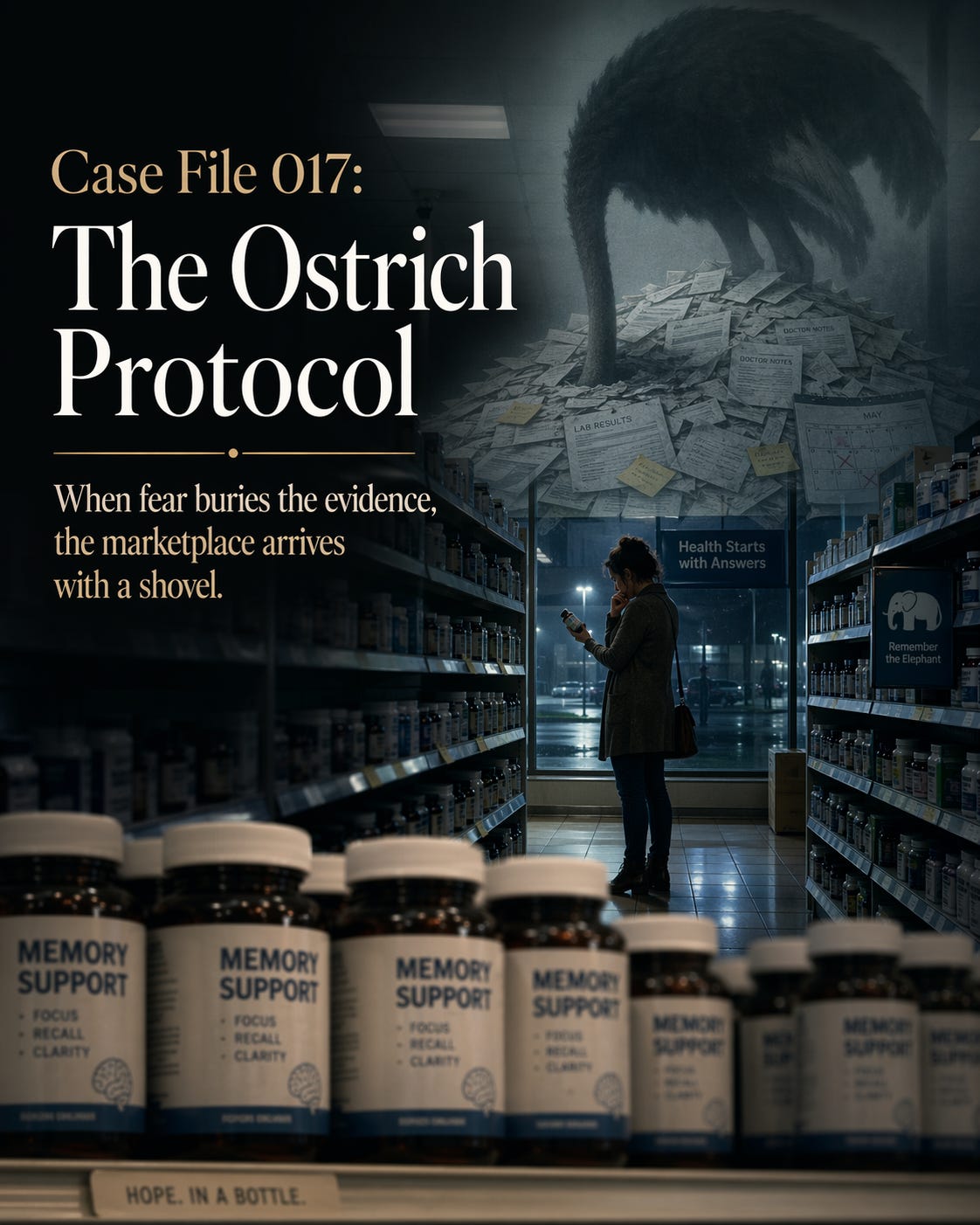
Not because families are foolish.
Because terror is clever.
It knows how to disguise itself as patience.
It knows how to say, “Let’s not overreact.”
It knows how to say, “We’ll mention it at the next appointment.”
It knows how to say, “He’s still doing pretty well.”
It knows how to turn avoidance into strategy.
And for a while, everyone cooperates.
The spouse does not want to force the conversation.
The adult children do not want to offend.
The person changing does not want to be watched.
The doctor does not want to alarm.
The system, meanwhile, is very comfortable with delay.
Delay has paperwork.
Delay has manners.
Delay has a calendar full of appointments six months from now.
But the disease does not wait for consensus.
That is the first lie of the Ostrich Protocol.
That time spent not knowing is neutral.
It is not neutral.
It is where habits erode.
It is where confidence collapses.
It is where the household begins quietly absorbing the damage without naming it.
And into that unspoken fear, the marketplace arrives.
Bright label.
Soft font.
Scientific-sounding promise.
Memory support.
Brain health.
Clinically studied.
Sharpness.
Focus.
Clarity.
A bottle small enough to fit in a medicine cabinet and expensive enough to feel like action.
This is not treatment.
It is emotional camouflage with a barcode.
The functional foods and supplements world knows exactly where the fear lives.
It knows the spouse who is not ready for neurology.
It knows the adult child Googling symptoms at 1:13 a.m.
It knows the person who has begun to suspect something is wrong but still wants a story where the problem is reversible with a capsule and optimism.
It knows that panic is a consumer category.
That is where Vivian finds the pattern.
Not in the clinic.
Not in the chart.
In the aisle.
A wall of promises staring back at people who have not yet been given a real plan.
She stands there one afternoon under pharmacy lighting that makes everyone look slightly guilty.
Prevagen.
Memory blends.
Brain boosters.
Focus formulas.
Neuro this.
Cognitive that.
Little bottles of plausible hope.
None of them say, “We will fix Alzheimer’s.”
They are too careful for that.
They do something slipperier.
They hover near the wound.
They suggest without stating.
They comfort without committing.
They sell proximity to science without accepting the burden of medicine.
The labels do not need to lie boldly.
They only need to arrive before the family has language.
Before diagnosis.
Before neurology.
Before imaging.
Before anyone has sat at the kitchen table and said, “This is real.”
Fear does the rest.
The Ostrich Protocol does not begin with denial.
It begins with bargaining.
Maybe it is stress.
Maybe it is sleep.
Maybe it is aging.
Maybe it is the medication.
Maybe it is grief.
Maybe it is retirement.
Maybe it is too much screen time.
Maybe he just needs to do more puzzles.
Maybe she just needs supplements.
Maybe we do not need to know yet.
Maybe knowing will make it worse.
That last one is the dagger.
Because many families believe, somewhere in the locked room of the heart, that diagnosis is not information.
It is a sentence.
They think if they do not name it, they can hold the life together longer.
They think the word itself is the thing that begins the ending.
Vivian understands this.
She does not mock it.
She has lived close enough to fear to know it is not stupidity.
Fear is a survival instinct wearing the wrong shoes.
But she also knows this.
Avoidance does not preserve the person.
It only preserves the illusion that the family is not yet inside the problem.
By the time most households seek help, they have already built a shadow care system.
The spouse is managing the appointments.
The spouse is checking the stove.
The spouse is repeating the morning plan.
The spouse is editing social situations.
The spouse is preventing embarrassment.
The spouse is translating confusion into something gentler.
The spouse is catching the dropped plates before anyone official hears them break.
And because the household has gotten good at compensation, the system mistakes the performance for stability.
Still independent.
Still conversational.
Still pleasant.
Still oriented.
Still mostly fine.
There it is again.
The phrase that should come with a warning label.
Mostly fine.
Mostly fine is where urgency goes to die.
The chart records function.
The house records cost.
There is no billing code for the moment a wife realizes she can no longer leave her husband with a complicated errand.
There is no dropdown menu for the way a husband stops trusting himself to answer the phone.
There is no clean field for the humiliation of needing help but not yet qualifying for help.
There is no clinical score for the argument avoided because everyone is too frightened to say what the argument is really about.
So the family keeps going.
The disease keeps moving.
The marketplace keeps selling.
The medical system keeps measuring decline with tools that often feel less like early warning systems and more like collapse confirmation devices.
MoCA.
Clock drawing.
Recall lists.
Scores that may be useful, yes, but often arrive like rulers brought to a house after the flood has already soaked the walls.
Vivian watches one assessment through the glass.
The man in the room is charming.
Funny.
Cooperative.
He jokes with the clinician.
He remembers enough to pass as himself.
His wife sits behind him, hands folded, face arranged into something socially acceptable.
Vivian sees the wife’s foot tapping.
One tap.
Two.
Three.
A metronome of contained testimony.
The clinician asks the man the date.
He hesitates.
Finds it.
Smiles.
The clinician makes a note.
The wife closes her eyes.
Because she knows what the chart will not know.
He checked the calendar before they left the house.
Twice.
She reminded him in the car.
Once.
He asked again in the elevator.
The answer he gave was not memory.
It was scaffolding.
But scaffolding looks like structure if nobody asks who built it.
This is one of the central frauds of early cognitive care.
Not fraud in the criminal sense.
Worse, in some ways.
Fraud by omission.
Fraud by format.
Fraud by misplaced attention.
The system evaluates the visible person and misses the invisible labor holding him upright.
Then it sends everyone home with a plan that sounds almost reasonable.
Follow up in six months.
Monitor changes.
Continue current medication.
Consider lifestyle modifications.
Call if symptoms worsen.
Call if symptoms worsen.
As though the household has not been calling in its own way for months.
Through missed routines.
Through altered temperament.
Through the spouse’s exhaustion.
Through the quiet terror of someone who knows the person they love is still there, but harder to reach.
The Ostrich Protocol is not only a family pattern.
It is a system pattern.
Everyone looks away a little.
Families look away because the truth hurts.
Clinicians look away because the pathway is narrow.
Insurers look away because ambiguity is cheaper than response.
Supplement companies look directly at the fear, then package it in a bottle.
And somewhere in the middle sits the person with the changing brain.
Still aware enough to be ashamed.
Still capable enough to be underestimated.
Still frightened enough to cooperate with everyone else’s silence.
That is the cruelty of the early stage.
The person is not gone.
Not even close.
They are still themselves.
But the world around them often behaves as if there are only two categories.
Fine.
Or gone.
Functioning.
Or unsafe.
Independent.
Or needing placement.
The middle is where families actually live.
The middle is where identity can still be protected.
The middle is where routines still matter.
The middle is where purpose still works.
The middle is where dignity can either be preserved or quietly stripped away by fear, delay, and bad design.
This is where MiM belongs.
Not as cure.
Not as fantasy.
Not as some shiny little app pretending the dragon is a house cat.
As infrastructure.
As a bridge between diagnosis and daily life.
As a place where the person is not treated like a crisis waiting to happen, but as a human being still capable of rhythm, contribution, choice, humor, movement, and meaning.
Because here is the part the system continues to miss.
A diagnosis should not be the moment a person is socially erased.
It should be the moment the household gets tools.
Not pamphlets.
Not shame.
Not vague encouragement to stay active.
Tools.
Structure.
Language.
A daily operating system.
Supporters who understand what they are supporting.
A way to preserve capability without pretending the disease is not real.
A way to say, “Yes, something is changing, and no, we are not surrendering the whole person to it.”
The Ostrich Protocol thrives in the absence of such tools.
It thrives when families believe the only choices are denial or devastation.
It thrives when diagnosis feels like stepping off a cliff instead of entering a better-supported road.
It thrives when the medical answer is a prescription, an infusion possibility, a scan, a score, and then a long silence where daily life is supposed to manage itself.
But daily life does not manage itself.
Someone manages it.
Usually the spouse.
Usually while pretending not to.
Usually while becoming the calendar, the reminder system, the emotional shock absorber, the transportation department, the historian, the translator, the advocate, the cleaner of messes nobody else sees.
And then someone asks her how she is coping.
As if coping were the goal.
Vivian stops writing.
The room is quiet except for the old radiator knocking in the wall like a nervous witness.
On her desk is a file folder marked CID_PROTOCOL.
Beside it, a photograph.
A couple at a kitchen table.
He is laughing.
She is looking at him with the complicated devotion of someone already counting the exits.
In the margin, Vivian has written one sentence.
Fear is not the enemy.
Unstructured fear is.
That is the case.
Not that families are wrong to be afraid.
They are right to be afraid.
They have seen enough.
They know enough.
They feel the floor tilting before the official instruments detect the angle.
The failure is not their fear.
The failure is leaving them alone with it.
That is where the false promises enter.
That is where the labels glow.
That is where the ostrich becomes a business model.
Head in the sand.
Wallet in the aisle.
Spouse in the parking lot, holding back tears beside a shopping cart full of hope she cannot quite defend.
The Custodian would call this unfortunate.
The Curator would call it consumer choice.
Vivian Quinn calls it evidence.
And this time, she does not file it under supplements.
She files it under delay.
Because the bottle was never the beginning of the story.
It was the receipt.
The proof that someone had been afraid for a long time and had nowhere better to go.
Subscribe to Memory in Motion.
We know what’s coming. We’re living anyway. Memory in Motion is for those who choose to keep moving, keep building, and keep loving, no matter the odds.