


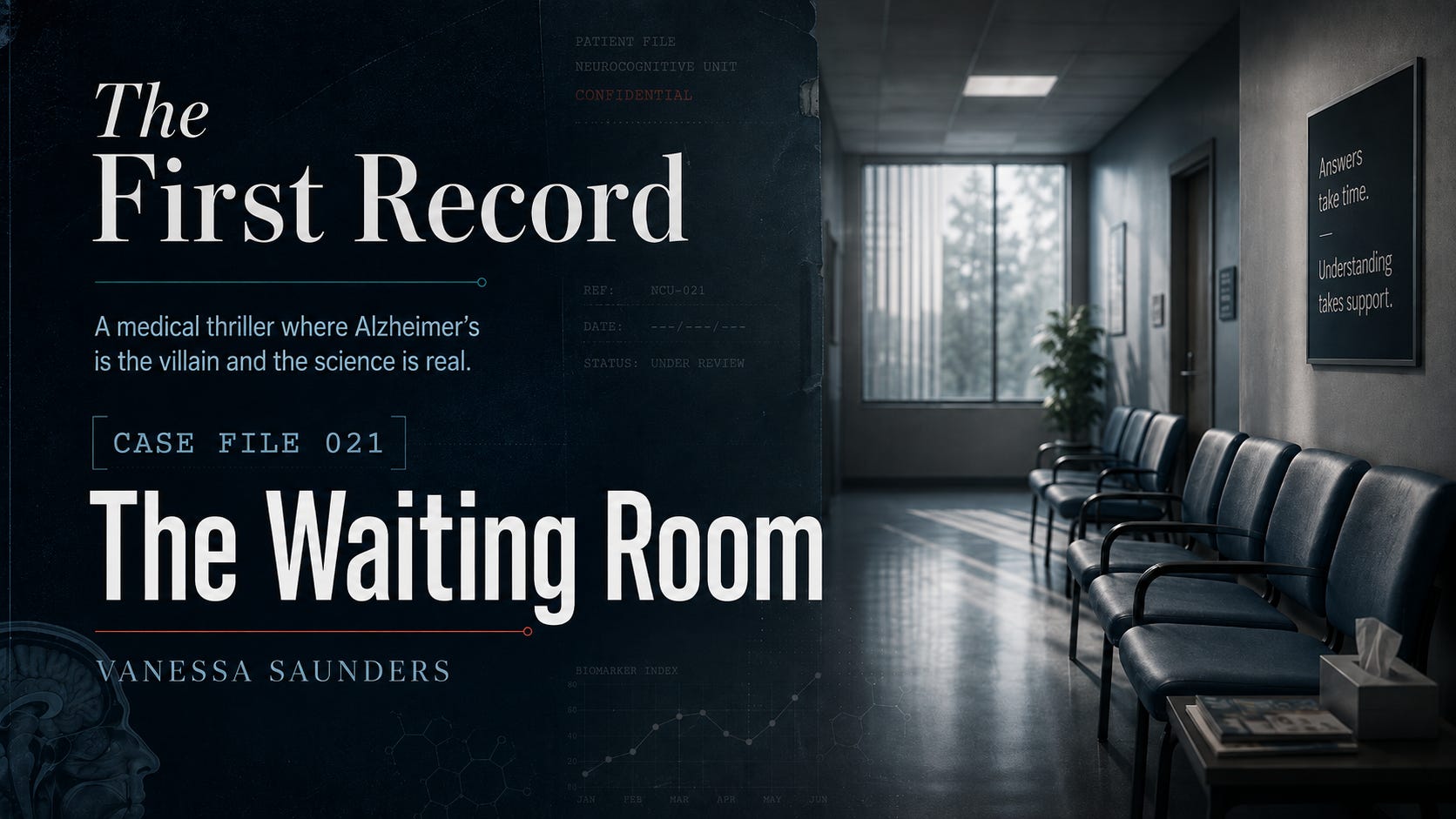
There is a particular kind of waiting room that families know too well.
Not the one with the old magazines, the humming fluorescent lights, and the slightly defeated plant in the corner, although those usually make an appearance, because apparently modern medicine cannot function without one sad ficus acting as emotional support foliage.
I mean the other waiting room.
The one that begins after the appointment.
After the scan.
After the test result.
After the word Alzheimer’s has entered the room and refused, quite rudely, to leave.
That is the waiting room most people are not prepared for.
It is not always physical. Sometimes it is a kitchen table. Sometimes it is the passenger seat of a car after the doctor’s office. Sometimes it is the hour after a phone call, when everyone keeps moving around the house as if the furniture has suddenly become unfamiliar.
The diagnosis has arrived.
The support has not.
And there they are.
Waiting.
Waiting for the follow-up appointment.
Waiting for the referral.
Waiting for the specialist.
Waiting for the insurance answer.
Waiting for the next scan.
Waiting to understand what the first scan meant.
Waiting to find out whether the drug is appropriate.
Waiting to find out whether the person they love is “too early,” “too late,” “not eligible,” “not advanced enough,” “too advanced,” or sitting in that most exquisite administrative swamp known as “we’ll review the records and get back to you.”
Meanwhile, life does not wait.
The bills still come.
The dog still needs feeding.
The car keys still sit on the counter.
The calendar still expects everyone to know what Tuesday means.
The person who received the diagnosis still wants to be treated like a person, not a walking risk assessment wearing sensible shoes.
And the family, who may have just been handed one of the most devastating pieces of information of their lives, is expected to become calm, organized, emotionally fluent, medically literate, legally prepared, financially aware, and gently encouraging by Thursday.
Possibly Wednesday, if the portal message comes through early.
This is the gap no one likes to name.
Diagnosis is an event.
Support is supposed to be a system.
Too often, families get the event and then are left to build the system themselves out of internet searches, whispered conversations, half-understood pamphlets, Facebook groups, and whatever emotional scaffolding they can assemble before the next thing goes wrong.
This is not because doctors do not care.
Many do.
This is not because researchers are not working.
They are.
This is not because families are unreasonable.
They are often being heroic in ways no one sees because heroism, in this particular arena, usually looks like remembering the pharmacy hours, not waving a sword from a hilltop.
The problem is structural.
Medicine has become increasingly good at detecting disease earlier.
Biomarkers can reveal what the eye cannot see.
Blood tests are moving faster.
Scans are improving.
Risk can be quantified.
Decline can be measured.
The record can begin earlier than ever.
That sounds like progress.
And in many ways, it is.
But early detection without early support is not a bridge.
It is a cliff with better signage.
Because once a person knows, or once a family suspects, everything changes.
The ordinary day becomes evidence.
A forgotten word is no longer just a forgotten word.
A missed turn is no longer just a missed turn.
A repeated question becomes a data point.
A misplaced wallet becomes a warning.
A quiet withdrawal at dinner becomes something everyone notices and no one knows how to discuss.
Families begin living inside a second record.
Not the medical record.
The household record.
The one written in glances, pauses, arguments, workarounds, calendar notes, receipts, pill boxes, driving routes, unfinished tasks, and the strange little negotiations that happen when love meets fear at the kitchen counter.
This record is usually invisible to the system.
The system sees the appointment.
The household sees the Tuesday afternoon when he could not remember why he had gone to the store.
The system sees the score.
The household sees the way she stopped making the recipe she had made for forty years.
The system sees the diagnosis.
The household sees the person trying desperately not to become the diagnosis.
And so the waiting room expands.
It fills the house.
It fills the marriage.
It fills the adult children’s group chat.
It sits beside the bed at three in the morning, whispering deeply unhelpful things like, “What now?”
That question is not small.
What now?
Not medically.
Not abstractly.
Not in the glossy brochure sense.
Actually.
What now, today?
Who talks to whom?
Who explains what?
Who tracks the appointments?
Who notices changes?
Who protects independence without pretending nothing is changing?
Who helps the person stay themselves while the system busily turns them into a chart?
Who supports the Supporter?
Who builds the daily structure between diagnosis and crisis?
Because that is where so much of Alzheimer’s actually happens.
Not in the dramatic moment.
Not in the final stage people imagine.
But in the long middle.
The waiting room.
The part where everyone knows something is happening, but no one has been given enough practical help to live with it well.
This is one of the reasons I keep coming back to records in The First Record.
Not because records are tidy.
They are not.
Records can protect.
Records can erase.
Records can reveal.
Records can distort.
Records can make someone visible, or reduce them to the thinnest possible version of themselves.
A medical record may say “mild cognitive impairment.”
A family may be living with the emotional weather system that sentence creates.
A chart may say “early Alzheimer’s.”
A husband may still be cooking dinner, walking the dogs, arguing about the thermostat, and insisting he is not a project.
A wife may be trying to honor that truth while also quietly wondering whether the keys should still be where they are.
This is not denial.
This is love trying to negotiate with uncertainty, which is about as relaxing as playing chess during an earthquake.
The waiting room is where agency is tested.
It is where people decide whether to speak, hide, plan, avoid, adapt, fight, comply, resist, or pretend they have read the portal notes when really they opened them, saw three acronyms and a sentence written by a committee of caffeinated ghosts, and closed the laptop.
The waiting room is where families become experts by necessity.
Not because anyone trained them.
Because the gap demanded it.
In a better world, diagnosis would come with a living bridge.
Not just a folder.
Not just a referral.
Not just a cheerful instruction to “stay active” delivered as if daily life were a motivational poster with sneakers.
A real bridge.
What changes now.
What does not.
What to watch for.
What to write down.
How to talk about driving.
How to preserve routines.
How to support memory without infantilizing the person.
How to plan without panicking.
How to help without taking over.
How to keep the person in the center of their own life for as long as possible.
That is the work.
That is the missing architecture.
And that is why the waiting room matters.
Because when support arrives late, fear gets there first.
Fear fills the empty chair.
Fear writes the family script.
Fear turns every mistake into a forecast.
Fear makes everyone either overreact or underreact, and sometimes, for variety, both before lunch.
But when support arrives early, something different becomes possible.
Not a cure.
Not a miracle.
Not the happy little bow people like to tie around hard things so nobody has to feel uncomfortable.
Something better than denial.
A plan.
A rhythm.
A shared language.
A way to notice change without making the person feel watched.
A way to help without swallowing the person whole.
A way to turn the household record into something useful before crisis becomes the author.
That is the space I care about.
The space between knowing and being helped.
The space between diagnosis and daily life.
The space where families are too often told to wait, while the disease gets busy.
In The First Record, that space becomes dangerous.
In real life, it already is.
Because the first record is never only medical.
It is also personal.
Who gets seen.
Who gets believed.
Who gets supported.
Who gets reduced.
Who gets to remain the author of their own life.
The waiting room is not empty.
It is full of families holding information they do not yet know how to live with.
And that should trouble us.
Because answers may take time.
But support should not.
If this Case File made you think of someone sitting in that waiting room after diagnosis, or living in the long middle without enough support, please share it with them.
And if you are following The First Record, the medical thriller at the center of this series, subscribe to keep receiving the Case Files as the story moves closer to publication.
The science is real.
The silence around what happens next is the part we need to break.
Hi Vanessa ! You nailed it again ! Practical , kind , thoughtful . Thank you !