

The Consent Trap
When Dementia Turns Paperwork Into a Locked Door

Why “having the documents” is not always the same as having access when memory loss enters the room.
I first posted this on Disrupting the Deal, but it absolutely belongs here too.
Because dementia does not just affect memory.
It can affect access.
Access to money.
Access to signatures.
Access to decisions.
Access to the daily machinery of a household.
Families are often told to “get a Power of Attorney” and “have the documents in order.”
Good.
But not enough.
The real question is not just whether you have documents.
The real question is whether the institution holding the money, records, benefits, or account will accept those documents for the exact action needed, at the exact moment needed, after capacity has changed.
That is the trap.
And it is why MiM exists in the gap between diagnosis and daily life.
Not as legal advice.
Not as financial advice.
As a practical reminder that families need structure before crisis becomes the project manager.
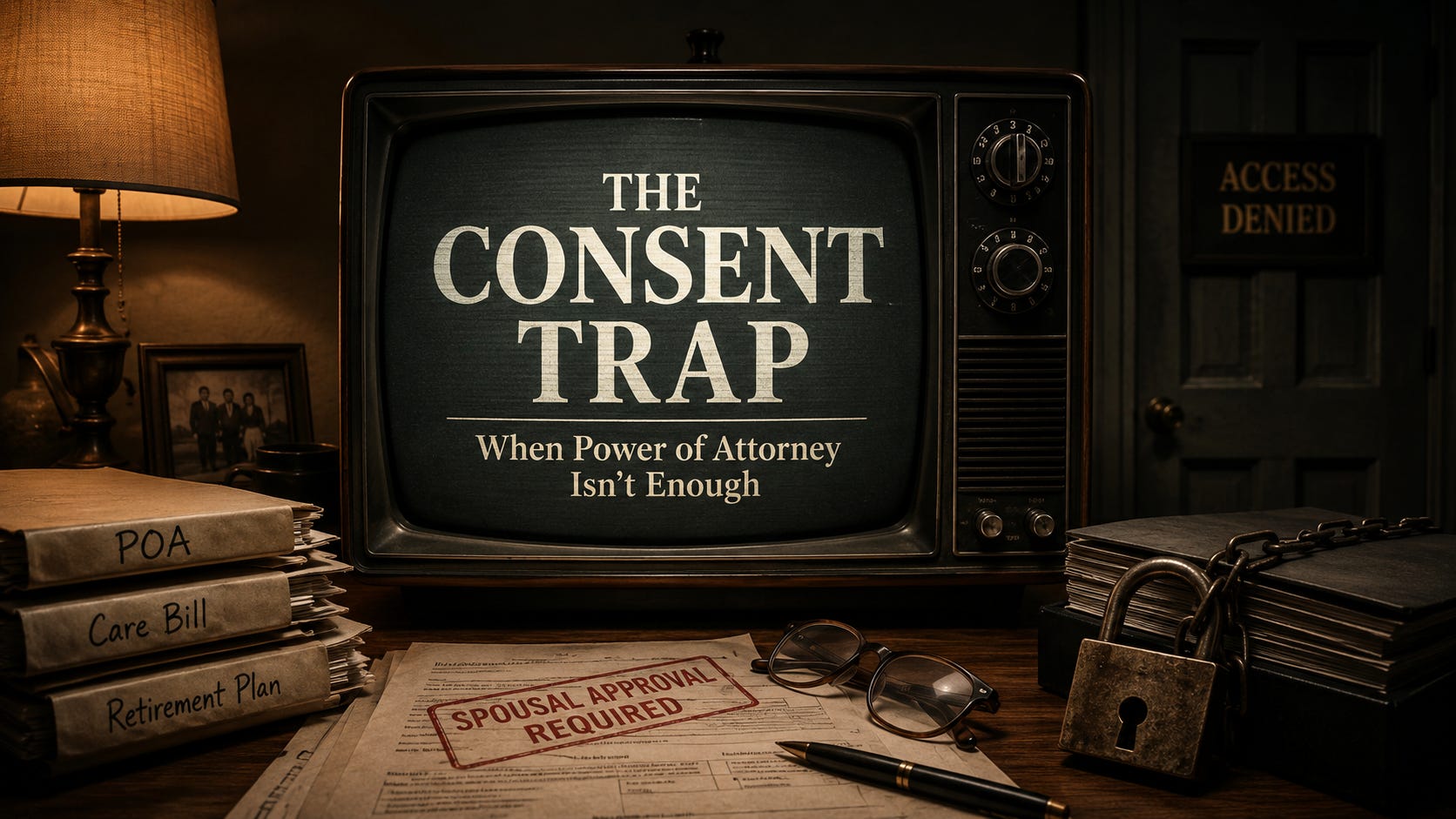
The Consent Trap
When Power of Attorney Isn’t Enough and Dementia Turns Paperwork Into a Locked Door
Did you know dementia can lock you out of your own money?
Not metaphorically.
Not emotionally.
Not in the poetic, tragic way people write about memory loss when they are trying to make it sound soft enough for a brochure.
I mean literally.
A caregiver may have a Power of Attorney.
The retirement account may be in their own name.
The money may be needed to pay for a spouse’s long-term care.
The spouse may no longer be able to meaningfully consent.
And the institution may still say:
“We need spousal approval.”
There it is.
The sentence that turns caregiving into a locked-room drama, except there is no charming detective, no dramatic courtroom reveal, and no one from the network calling to ask who should play you in the limited series.
Just you.
A bill.
A policy.
A spouse who cannot sign.
And a document you were told would protect you.
Previously, on “Nobody Warned Us About This”
Families are told to prepare.
Get a Power of Attorney.
Get the documents signed.
Put everything in a binder.
Make sure the paperwork is in order.
This advice sounds responsible. Sensible. Adult.
The kind of thing people say while nodding seriously near a conference table.
And yes, Power of Attorney matters.
It can be essential.
But here is the part families are not always told:
A Power of Attorney may not be enough in every financial or retirement-plan situation.
It may not satisfy every bank.
It may not satisfy every retirement-plan administrator.
It may not include the specific powers needed.
It may not override plan rules.
It may not answer the question no one thought to ask early enough:
What happens if the person who needs to consent can no longer consent?
That is the trap.
Not the missing document.
The false sense of safety.
Before the Cringy Comments Arrive
Let us clear the runway before the internet pulls up in its little judgment scooter.
No, this is not legal advice.
No, this is not financial advice.
No, this is not tax advice.
No, this is not Medicaid advice.
No, this is not “everyone should get divorced.”
No, this is not “marriage is the problem.”
No, this is not “retirement-plan safeguards are evil.”
And no, “you should have planned better” is not the wisdom grenade some people seem to think it is.
The issue is not that families fail to plan.
The issue is that families are often told to plan in slogans.
“Get your affairs in order.”
“Have the documents.”
“Make sure someone has POA.”
Lovely.
Very tidy.
Very brochure-friendly.
Very much not enough.
Because the real question is not:
Do you have a Power of Attorney?
The real question is:
Will the institution holding the money accept that Power of Attorney for the exact action you need, at the exact moment you need it, after the person you love has lost capacity?
That is a very different question.
And it is the question almost no one is told to ask.
The Signature Becomes the Villain
In dementia care, people talk about memory.
They talk about diagnosis.
They talk about medications, safety, driving, wandering, and caregiver stress.
All of that matters.
But there is another character in this story.
The signature.
The signature sits quietly in the background until one day it becomes the villain.
The spouse who once signed checks, tax returns, mortgage papers, beneficiary forms, retirement elections, and care documents can no longer understand what they are being asked to sign.
They cannot consent.
They cannot approve.
They cannot legally participate in the way the institution requires.
And now the family is stuck.
The person who needs protection is also the person whose consent may be required.
The caregiver has responsibility but not access.
Duty but not authority.
A bill but not a usable path.
That is not caregiving.
That is captivity with letterhead.
Protection Can Become Punishment
Some retirement-plan spousal consent rules exist for a good reason.
They are meant to protect spouses from being cut out, bypassed, disinherited, or financially harmed.
That matters.
A lot.
But protective systems can become punishing systems when incapacity enters the room and no one has built a practical way through it.
A safeguard can become a locked door.
A consent rule can become a crisis.
A document can become decorative.
A caregiver can become trapped between the person they love and the policy that claims to protect them.
And the most maddening part?
The caregiver may be trying to use the money to pay for the spouse’s care.
Not hide it.
Not steal it.
Not run off to Monaco with a tennis coach and a questionable linen wardrobe.
Pay. For. Care.
Yet the system can still say no.
That is the absurdity.
That is the scandal.
Dementia Does Not Just Steal Memory
Dementia can steal access.
Access to money.
Access to accounts.
Access to decisions.
Access to signatures.
Access to passwords.
Access to the ordinary machinery of a household.
Access to the life a family thought it had legally prepared for.
And once access is gone, love does not unlock the door.
Love can sit beside the bed.
Love can drive to the appointment.
Love can call the facility.
Love can label the drawers.
Love can remember the medications.
Love can argue with the pharmacy portal.
Love can keep showing up long after everyone else has gone quiet.
But love is not a court order.
Love is not plan language.
Love is not spousal consent.
Love is not a notarized institutional form.
Love, it turns out, has terrible administrative privileges.
“We Have a POA” Is Not the Same as “We Are Covered”
Please read that again.
A Power of Attorney can be essential.
But it is not a magic skeleton key.
It may not work everywhere.
It may not say enough.
It may be too old.
It may be too vague.
It may not include retirement-plan powers.
It may not include gifting powers.
It may not include Medicaid-planning authority.
It may not allow beneficiary changes.
It may not satisfy a bank’s internal review.
It may not satisfy a retirement-plan administrator.
It may not override plan rules requiring spousal consent.
And by the time the gap appears, the person who could fix it may no longer have legal capacity.
That is the warning.
Not panic.
Not cynicism.
Not “burn the system down,” although one understands the impulse and may briefly admire the lighting.
The warning is this:
Do not confuse having documents with having access.
The Diagnosis After the Diagnosis
The first diagnosis may be medical.
Alzheimer’s.
Dementia.
Lewy body dementia.
Parkinson’s with cognitive changes.
Posterior cortical atrophy.
Stroke-related impairment.
Mild cognitive impairment that is not so mild when bills, passwords, accounts, and signatures enter the chat.
But then comes the second diagnosis.
The household diagnosis.
The legal diagnosis.
The financial diagnosis.
The administrative diagnosis.
Who can sign?
Who can access?
Who can decide?
Who can move money?
Who can talk to the bank?
Who can change beneficiaries?
Who can manage retirement plans?
Who can sell the house?
Who can apply for benefits?
Who can authorize care?
Who can act when the person who used to act cannot?
That is where families get blindsided.
Because medicine tells them what may be happening in the brain.
But almost no one tells them what is about to happen to the household.
The Most Dangerous Sentence in Caregiving
There are many terrible sentences in dementia care.
“He is declining.”
“She cannot live alone anymore.”
“We need to talk about placement.”
“The care cost is increasing.”
But one of the most dangerous is quieter.
“We thought we were covered.”
That sentence breaks people.
Because it usually comes after they tried.
They were not careless.
They were not irresponsible.
They did not ignore reality.
They signed the papers.
They made the binder.
They trusted the advice.
They believed the system had a door marked “family crisis, enter here.”
Instead, they found a locked gate, a policy number, and hold music telling them their call is very important.
The Wrong Question
When a caregiver says, “I should have divorced him,” people tend to gasp.
They hear betrayal.
They hear anger.
They hear something socially unacceptable, which is often the only kind of sentence honest enough to get through the wallpaper.
But listen more carefully.
She may not be giving marriage advice.
She may be describing financial entrapment.
She may be saying:
I was told loyalty would protect us.
I was told paperwork would protect us.
I was told staying married was the right thing.
I was told a Power of Attorney was enough.
Now I have responsibility without authority.
Bills without access.
Duty without control.
A spouse I love and cannot get consent from.
A system that praises caregivers in public and blocks them in private.
That is not a character flaw.
That is a flare shot into the sky.
The real question is not:
Should she have divorced him?
The real question is:
Why are families not told early enough which legal and financial doors may close once capacity changes?
That is the conversation.
Every Diagnosis Should Come With an Access Plan
Not just a care plan.
An access plan.
A practical, plain-English review of what happens when the person with memory loss can no longer sign, consent, approve, remember, authorize, explain, or participate in financial decisions.
Because families do not just need to know what the disease may do.
They need to know what the system may do next.
An access plan asks:
Who can access which accounts?
Who can speak to which institutions?
Who can move money?
Who can make care decisions?
Who can sign forms?
Who can update documents?
Who can handle retirement plans?
Who can manage insurance?
Who can deal with Medicaid or benefits?
Who can act if the current documents are rejected?
This should happen early.
Before the care bill spikes.
Before the crisis.
Before the first locked door.
Before the person who needs to consent cannot consent.
The Questions Families Should Ask Now
Make a list of every institution connected to the household.
Banks.
Retirement accounts.
403(b)s.
401(k)s.
Pensions.
IRAs.
Annuities.
Life insurance.
Long-term care insurance.
Mortgage company.
Investment accounts.
Credit cards.
Social Security.
Medicare.
Medicaid office, if relevant.
Care facility.
Attorney.
Accountant.
Financial advisor.
Employer benefits office.
Then ask the questions that sound paranoid until they become urgent.
Will you accept our current Power of Attorney?
Do you require your own form?
Does the POA need specific retirement-plan language?
Can an agent act for a spouse who no longer has capacity?
Do any transactions require spousal consent?
Does a withdrawal, loan, beneficiary change, annuity election, rollover, or distribution require a spouse’s signature?
What happens if the spouse cannot sign?
Would you require guardianship?
Conservatorship?
A court order?
A legal opinion?
A notarized form?
A plan-specific waiver?
Is there a procedure for incapacity?
Can we get your requirements in writing?
These are not romantic questions.
Neither is being financially locked out while trying to pay for care.
Do This While the Person Can Still Participate
That is the uncomfortable truth.
Families avoid these conversations because they feel harsh.
Premature.
Disloyal.
Cold.
Like giving in.
But avoiding the conversation does not protect the person with memory loss.
It may actually leave them more vulnerable.
It may leave the Supporter powerless.
It may leave the household exposed.
It may leave everyone dependent on a court process no one wanted, at a cost no one planned for, during a crisis everyone hoped would never come.
This is not about stripping someone of agency.
It is about preserving as much agency as possible before the system starts making decisions by default.
This Is Why MiM Exists in the Gap
MiM is not a law firm.
MiM is not a financial planner.
MiM is not a benefits administrator.
MiM is not medical advice wearing a tasteful scarf.
MiM exists because families are dropped into the space between diagnosis and daily life and told to “cope.”
As if coping is a strategy.
As if love is a filing system.
As if memory loss politely confines itself to memory.
It does not.
It reaches into the calendar.
The kitchen.
The car keys.
The medicine cabinet.
The bank account.
The retirement plan.
The passwords.
The marriage.
The adult children.
The care bill.
The identity of the person diagnosed.
The identity of the person supporting them.
And every tiny place where life used to run on assumption.
MiM is being built for that space.
The messy middle.
The practical middle.
The human middle.
The place where families need structure before crisis becomes the project manager.
The Controversial Part
Most families are not underprepared because they do not care.
They are underprepared because the system gives them fragments and calls it guidance.
A doctor gives a diagnosis.
An attorney drafts documents.
A financial institution follows policy.
A retirement plan follows plan rules.
A care facility sends invoices.
A Medicaid office has its own framework.
A bank has its own forms.
A spouse has grief.
Adult children have confusion.
Everyone has a piece.
No one owns the whole picture.
So the family becomes the integration system.
And when the integration fails, somehow the caregiver gets blamed.
That is obscene.
Quietly obscene, which is often the most dangerous kind.
So Yes, Get the Power of Attorney.
But do not stop there.
Test it.
Pressure-test it.
Ask where it fails.
Ask who will accept it.
Ask what requires spousal consent.
Ask what happens after incapacity.
Ask what happens if care costs rise.
Ask what happens if the spouse at home needs money to survive too.
Ask what happens if the spouse in care cannot sign.
Ask what happens if the retirement account says no.
Ask before the disease takes the signature.
Ask before the account becomes a locked box.
Ask before everyone is exhausted.
Ask before the crisis gets a vote.
Families Deserve Better Than Surprise Traps
They deserve more than sympathy.
They deserve more than pamphlets.
They deserve more than “make sure your documents are in order,” as though documents are magical household elves that leap into action when the bills arrive.
They deserve practical questions.
Early warnings.
Plain language.
Real planning.
And a system honest enough to admit that caregiving is not only emotional labor.
It is legal labor.
Financial labor.
Administrative labor.
Cognitive labor.
Invisible labor.
Often unpaid.
Often unsupported.
Often performed by women who are praised for their devotion right up until they ask for access.
Then suddenly everyone gets very interested in policy.
Final Thought
Dementia can steal names.
Dates.
Stories.
Directions.
Faces.
Routines.
But sometimes, the system steals something too.
Time.
Access.
Authority.
Options.
The caregiver’s belief that doing the right thing will be enough.
That may be the cruelest theft of all.
So no, the lesson is not “never marry.”
The lesson is not “divorce before disaster.”
The lesson is not “trust no one,” although frankly, read the forms.
The lesson is this:
Do not wait until memory loss becomes a legal problem to ask legal questions.
Do not wait until care becomes unaffordable to ask financial questions.
Do not wait until the person you love can no longer sign to find out which signatures matter.
And do not let anyone shame caregivers for being furious when a system gives them all the responsibility and none of the access.
That is not protection.
That is a trap with nicer stationery.
And families deserve a map before they fall into it.
Important note: This post is general information only. It is not legal, financial, tax, Medicaid, retirement-plan, or medical advice. Rules vary by state, account type, employer plan, ERISA status, plan document, Medicaid status, marital status, and capacity. Families should consult an elder-law attorney and qualified financial or benefits professional early.