

Welcome to Scamistan
Where the Prince Needs a Realtor and Everyone Else Needs a Nervous System

The some time ago, a Royal Prince of Somewhere-or-Other contacted me directly on LinkedIn.
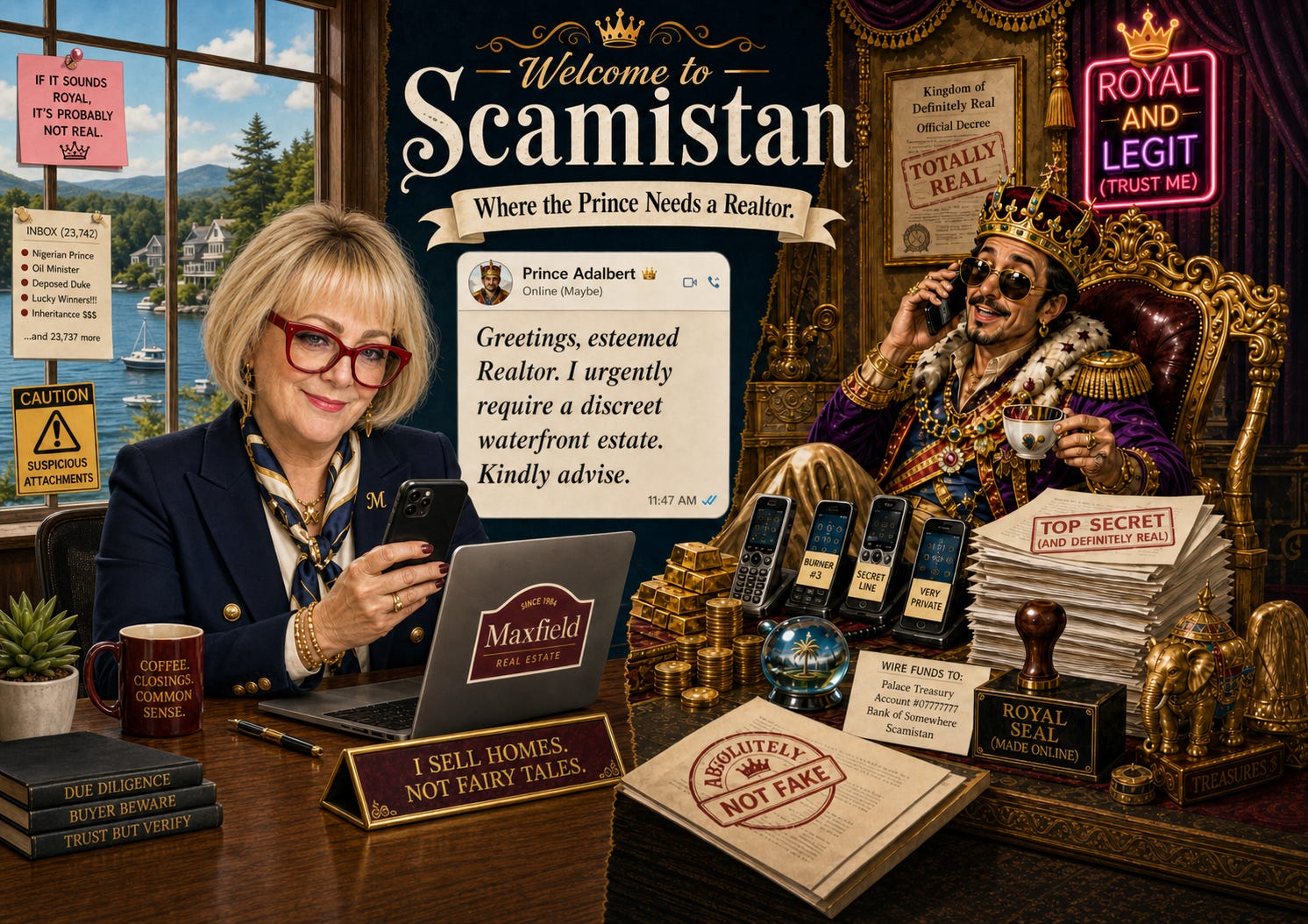
Obviously.
Because when royalty needs real estate representation, they do not consult their solicitor, wealth manager, ambassador, family office, or discreet international advisor.
No.
They message a New Hampshire broker on LinkedIn.
As one does.
I assume the crown jewels were temporarily unavailable, the palace Wi-Fi was spotty, and His Royal Highness had decided that what he really needed was someone in the Lakes Region to help him navigate waterfront inventory, septic setbacks, and possibly a modest castle with good broadband.
Reader, I did not respond.
Because while I am many things — broker, author, wife, grandmother, professional skeptic, part-time wrangler of chaos — I am not currently accepting imaginary monarchs with urgent transactional needs and a suspicious relationship with punctuation.
But it did get me thinking.
We are no longer merely dealing with scams.
We live in Scamistan now.
No passport required.
No customs line.
No duty-free.
Just your phone, your inbox, your Medicare card, your bank account, and the faint sensation that civilization has been replaced by a call center wearing a fake mustache.
Every day, Scamistan sends ambassadors.
A spoof call from “your bank.”
A text about an unpaid toll.
A Medicare “representative” who just needs to confirm your number.
A fake delivery notice.
A fake Amazon charge.
A fake PayPal invoice.
A fake Norton renewal.
A fake job offer.
A fake buyer.
A fake seller.
A fake romance.
A fake prince.
A fake emergency.
A fake broker email with one letter changed in the address and all the menace of a raccoon holding a fountain pen.
And they all have the same basic message:
Act now.
Click here.
Verify this.
Send money.
Do not tell anyone.
Kindly respond.
The word “kindly” alone should be treated as a small siren with legs.
This would all be almost funny if it were not so relentless.
Almost.
Because there is something deeply Monty Python about the whole thing.
“Good morning, madam. I am the Royal Prince of International Urgency and I require your immediate assistance purchasing a discreet waterfront estate. Please provide routing number, blood type, mother’s maiden name, and perhaps one small gift card for administrative purposes.”
Cue coconuts. Cue absurd hats. Cue the Ministry of Fraudulent Walks.
But underneath the comedy is something much darker.
Because Scamistan does not just steal money.
It steals attention.
It steals trust.
It steals calm.
It forces every ordinary person to become a full-time fraud analyst, cyber-security intern, banking compliance officer, Medicare investigator, email forensics specialist, and emotional triage nurse before breakfast.
And if you are caring for someone with Alzheimer’s, cognitive impairment, CID, illness, grief, or plain old caregiver overload?
This is not funny.
This is terrifying.
Because scams are designed to exploit the very things cognitive change makes harder.
Memory.
Attention.
Sequencing.
Judgment.
Impulse control.
Trust.
Emotional regulation.
The ability to pause and say, “Wait. Something feels off.”
Every fake Medicare call asks for another decision.
Every fake bank alert creates another panic.
Every fake broker email demands another verification.
Every fake delivery text adds another little stone to the backpack.
Is this real?
Did I already answer this?
Was I supposed to pay this?
Did Medicare change something?
Is my bank actually calling?
Did my broker send that?
Did I forget?
That is not inconvenience.
That is cognitive ambush.
And caregivers are already living in a world of constant invisible labor.
Did he take the medication?
Did I refill the prescription?
Did we eat lunch?
Is the appointment today or tomorrow?
Where are the keys?
Why is the stove on?
Why is the insurance company calling?
Why is there another envelope from Medicare?
Why does every form require a password, a portal, a code, a backup code, and the patience of a medieval monk?
Then Scamistan strolls in wearing a blazer and says, “Kindly verify your account.”
No.
Absolutely not.
Go away and be ridiculous elsewhere.
And then there is real estate.
Real estate is already high-stakes, high-stress, deadline-heavy, paperwork-dense, and full of moving parts. It does not need extra villains. We already have appraisals, inspections, title issues, rate locks, septic questions, HOA documents, delayed closings, missing signatures, and the occasional seller who suddenly remembers they never mentioned the well was installed during the Carter administration.
Now add wire fraud.
A buyer receives what looks like legitimate wiring instructions right before closing. The email appears to come from the right person. The timing is perfect. The language sounds plausible. The buyer is rushed, excited, anxious, and surrounded by documents.
They wire the money.
But the money does not go to the title company.
It goes to a scammer in Whereveristan.
And now the closing cannot happen.
The buyer is devastated.
The seller is packed.
The movers are booked.
The lender is waiting.
The title company is scrambling.
The broker is horrified.
Everyone is staring at the smoking crater where a transaction used to be.
And the scammer?
Gone.
Floating away on a yacht named Kindly Confirm.
This is why I am so obsessive about verification. Not because I enjoy sounding like the village hall monitor. I do not. I have other hobbies. Sarcasm, mostly.
But because real estate wire fraud is not a theoretical risk. It happens. And when it happens, it is catastrophic.
You do not recover from “Oops, the closing funds went to a criminal” with a muffin basket and a cheerful email.
The answer is not “be careful.”
I am so tired of “be careful.”
“Be careful” is not a system.
“Be careful” is a shrug in sensible shoes.
We need actual procedures.
Call the title company using a known, verified number before wiring anything.
Do not trust wiring instructions sent by email alone.
Confirm any changes verbally, using a number you already know is legitimate.
Do not click links in urgent emails.
Do not share Medicare numbers with people who contact you out of the blue.
Do not pay anyone with gift cards unless you are buying an actual gift card for an actual human you actually know.
Use family code words for emergencies.
Use password managers.
Turn on account alerts.
Loop in a second trusted person for large financial decisions.
Pause without apology.
Because in Scamistan, speed is the weapon.
The scammer wants urgency.
The scammer wants panic.
The scammer wants you embarrassed.
The scammer wants you alone.
The scammer wants you to think asking for help means you are foolish.
That is the con.
Not the text.
Not the fake invoice.
Not the prince.
The real con is isolation.
So we fight it with systems, verification, and absolutely no shame.
If something feels off, stop.
If someone pressures you, stop.
If someone says not to tell your spouse, your child, your banker, your broker, your lawyer, or your dog, tell all of them.
Especially the dog.
The dog has excellent instincts and has never once recommended wiring money to a prince.
And for those of us caring for someone with cognitive change, this matters even more.
We cannot keep pretending that “digital literacy” is enough.
We need cognitive protection.
We need better guardrails.
We need plain-English fraud warnings.
We need banks, Medicare, title companies, brokerages, tech platforms, and families to understand that fraud prevention is not just a cybersecurity issue.
It is a dignity issue.
It is a caregiver issue.
It is a cognitive health issue.
It is a housing issue.
It is a closing issue.
It is a trust issue.
And frankly, it is a daily-life issue for every decent person trying to function while the Ministry of Nonsense blows a kazoo into their inbox.
So yes, laugh at the fake prince.
I certainly did.
But then build the system.
Because Scamistan is real.
Its ambassadors are busy.
And the rest of us need to stop pretending that vigilance alone can protect people from industrialized fraud dressed up as urgency.
Pause.
Verify.
Ask.
Document.
Tell someone.
And if royalty really does need help buying property in New Hampshire?
Lovely.
They can call the office, provide proof of funds, use a legitimate email address, and leave their coconuts at the door.
Two most noteworthy comments : beware suspicious punctuation and tell the dog ! Your whole post is crucial to understanding the constant need to watch for Scamistan !