

The Missing Box
How one tiny user-interface mistake is delaying technology that could help families living with memory loss

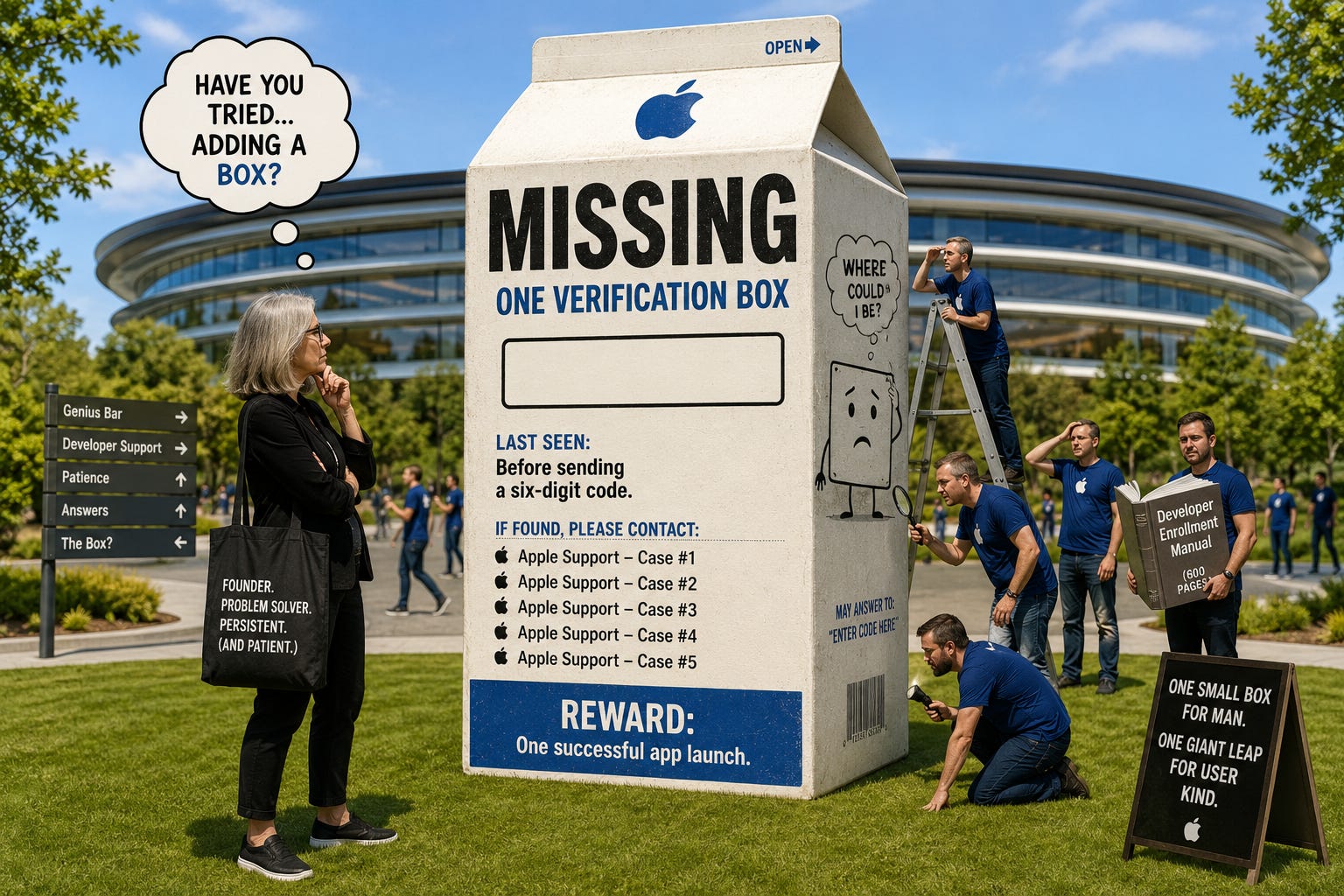
This saga did not begin last week.
It began months ago, when we discovered that the web-based version of Memory in Motion simply was not good enough on iPhones.
MiM needed to become a fully developed app.
So we began that process.
Then came Apple’s requirements.
More than a month ago, my company had to obtain something called a D-U-N-S Number.
I had never heard of one before.
Apparently, it is a unique nine-digit business identifier issued by Dun & Bradstreet so companies like Apple can verify that you are a real organization and not simply someone inventing a company over breakfast.
Fair enough.
So I applied.
Waited.
Verified my business.
Received my D-U-N-S Number.
Apple accepted it.
Excellent.
Progress.
Then Apple asked me to verify my business email.
They sent me a six-digit code.
There was just one problem.
There was nowhere to enter it.
Not hidden.
Not collapsed.
Not behind an “Advanced Settings” menu.
Not tucked away in some secret developer portal.
Nowhere.
The code exists.
The box does not.
That particular chapter began more than a week ago.
I naively thought it would take one phone call to resolve.
How adorable.
Since then, I have spent five and a half hours waiting on hold, plus many more hours talking, explaining, repeating, uploading documents, answering the same questions and collecting Apple case numbers like they are Air Miles.
I think I now have about five of them.
Enough, perhaps, to open my own customer support department.
Every Apple advisor begins in exactly the same way.
“Well, that should be an easy fix.”
Every.
Single.
One.
Until I prove it.
Because none of them believes me at first.
The initial assumption is always that I must have clicked the wrong button.
Missed the obvious menu.
Skipped a step.
Failed to notice something sitting directly in front of me.
There is, perhaps, a faint suggestion that the older lady on the telephone has simply become confused by the technology.
But I know when I have clicked the wrong button.
This is not that.
This is one missing box.
Only after I walk each advisor through the process do they pause and say some version of:
“You’re right. There really is nowhere to enter the code.”
Exactly.
Welcome to my week.
The first advisor hung up on me.
The second genuinely tried to help.
The third genuinely tried as well.
I was asked to upload additional verification documents through Apple’s secure portal.
I did.
Eventually, I reached Eric, who assured me that senior supervisors would contact me within twenty-four hours.
They did not.
I am still waiting.
Meanwhile, Apple’s wonderfully calm automated assistant greets me every time I call.
It takes my case number and reassures me that the next advisor will already have all my information, so I will not need to explain everything again.
That may be Apple’s greatest innovation.
Comedy.
Because every conversation begins with exactly the same questions.
My name.
My company.
My case number.
My problem.
Again.
And again.
And again.
Apparently, the system remembers everything.
It just does not share it with the humans.
The truly astonishing part is this.
Apple can recognize my face in complete darkness.
It can unlock my phone using nothing more than my smile.
It can tell me my heart rate.
Warn me if I have fallen over.
Track my luggage across continents.
Locate my watch.
Translate languages in real time.
Edit cinema-quality video.
Navigate me through unfamiliar cities.
Find a single AirTag attached to a suitcase somewhere on the planet.
But...
It cannot provide one small box in which I can enter six numbers.
That, apparently, is beyond the current state of human achievement.
Apple sent me the code.
Apple forgot the box.
Then there is Facebook.
Or Meta.
Or whatever the kingdom is calling itself this week.
I forgot my password.
Perfectly ordinary.
Millions of people forget passwords every day.
Facebook’s solution?
Send me a verification code.
Of course.
The code lets me log in.
Wonderful.
Except I do not simply want to log in.
I need to create a new password so I can update account information and delete an old page.
To create a new password, Facebook wants my old password.
The one I have forgotten.
Which is precisely why I clicked “Forgot Password” in the first place.
So let me get this straight.
Facebook accepts that I am me.
It sends a code to prove that I am me.
It lets me into the account because it has established that I am me.
Then it refuses to let me change anything because I cannot prove that I am me.
Again.
This is not security.
It is a hamster wheel with branding.
Or perhaps digital Groundhog Day.
And I cannot help wondering whether somewhere in Silicon Valley, developers are giving each other high-fives over these magnificent authentication systems while ordinary human beings quietly bang their heads against their keyboards.
Here is my theory.
The children writing these systems are undoubtedly brilliant programmers.
They can write elegant code.
Build extraordinary algorithms.
Create astonishing technology.
Automate entire support departments.
But somewhere along the way, they forgot to ask the simplest question of all.
Can an actual human being use this?
Not another developer.
Not someone who built the system.
A real person.
Someone who is tired.
Someone who has forgotten a password.
Someone trying to run a business.
Someone who simply wants to enter the code they were asked to enter.
The children at these enormous technology companies may be extremely clever.
But perhaps they are not quite as clever as they think they are.
Because complexity is not intelligence.
And technology is not successful merely because it is sophisticated.
It is successful because people can actually use it.
Technology should adapt to humans.
Humans should not have to adapt to technology.
And here is why this matters.
I am not trying to launch another game.
Or another shopping app.
Or another clever way to make cats sing karaoke.
I am trying to launch Memory in Motion.
MiM.
An app designed to help people living with memory change and the families who support them.
Our beta testers are waiting.
These are people who need structure, reassurance, confidence and dignity in lives that can already feel uncertain enough.
Every week matters.
Every delay matters.
Not because of a catastrophic system failure.
Not because of a cyberattack.
Not because of some impossibly complex engineering challenge.
But because somewhere inside Apple’s developer enrollment process...
...there is one missing box.
One.
Little.
Box.
Apparently, it is easy for everyone to identify.
Just not for anyone to fix.
I have asked Apple.
I have waited.
I have uploaded documents.
I have collected case numbers.
I have listened to enough hold music to recognize it in a police line-up.
I have explained the problem so many times I could probably train Apple’s support advisors myself.
I have even asked my trusted LLMs whether they could find a way through Apple’s maze.
They could not.
Apparently, this has now flummoxed the humans, the bots, the advisors, the supervisors and artificial intelligence itself.
Quite an achievement.
So, Mr. Cook, I do not need another advisor.
I do not need another case number.
I do not need another apology.
I do not need another promise that someone will call me back.
I need one person with the authority and technical ability to fix one missing box.
Mr. Altman... perhaps you have an idea.
Because at this point, I am willing to accept assistance from Apple, OpenAI...
...or divine intervention.
Steve Jobs, if you are listening, I could really use an angel right now.
The irony is impossible to ignore.
MiM exists because technology should make life easier for people experiencing memory change.
Yet here I am, trapped inside technology that cannot remember where it put its own verification box... or how to let someone reset a forgotten password.
The future of technology will not be decided by who writes the cleverest code.
It will be decided by who remembers the people trying to use it.
Have you ever been trapped inside a technology loop that nobody seemed able to fix?
Share your story in the comments.
I have a feeling Apple, Meta and I are not alone.
Oh Vanessa ! Just too bad to be true ! This delay is just not acceptable but who the hell is listening ? In the “ old days “ the old fashioned Ombudsman fixed a situation like this . Wish I had the answer , give me a phone number to complain and try at least . Maybe WMUR ?